Queue Warning
Cushion the slowdown — but only when the math works.
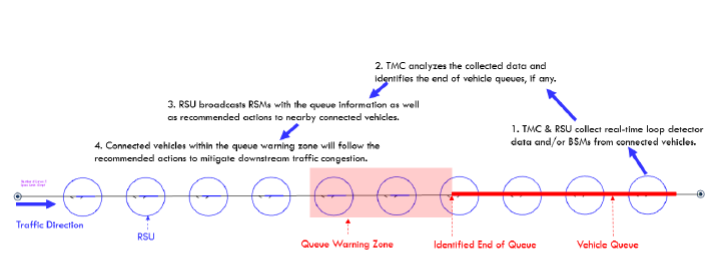
Queue Warning fuses loop-detector occupancy with BSM-derived vehicle speeds to find the end of a vehicle queue in real time, then asks upstream connected vehicles to slow down in two progressive zones. The aim: reduce rear-end crash exposure and smooth the merge into congestion.
How It Works
A 10-mile, 4-lane freeway with weaving sections every mile carries dual detection: 5-minute loop-detector averages and 30-second BSM speed aggregations. The TMC stitches them together to find the end of the queue, then RSUs broadcast tiered speed limits across a 2-mile warning zone.
Collect detector and BSM data
Each weaving section has upstream and downstream Vehicle Detector Stations 500 and 1,000 ft from the merging gore. CVs broadcast BSMs at 10 Hz. The RSU forwards both streams to the TMC.
Detect congestion
Loop occupancy above 25% (5-min average) or BSM-derived median speed below 25 mph (30-sec window) marks a section as congested. Both signals overlapping is fine; either triggers.
Identify the End of Queue
The TMC walks upstream from the most-downstream congested section until it finds an uncongested upstream segment. That boundary is the End of Queue.
Broadcast two-zone speed limits
RSMs are pushed at 1 Hz across the 2-mile queue warning zone: 45 mph in the first mile upstream of the EoQ, then 60 mph for the second mile. CVs comply 100% and gradually decelerate.
Queue Warning Zone Settings: why two zones, not one
- ◇A single low speed limit applied across the full zone overreacts to minor congestion and inflates delay.
- ◇Tiered limits let CVs decelerate progressively — closer to the queue means slower, further away means a milder reduction.
- ◇The zones move dynamically: as congestion grows, both EoQ and warning zone shift upstream; as it dissipates, they shift back downstream.
- ◇Lane-change and detour recommendations were considered but excluded — Aimsun's lane-change API behaves unrealistically and detours require Integrated Corridor Management.
Test Networks & Scenarios
Test Networks
10-mile · 4-lane freeway · 65 mph
Single representative California freeway segment. 10 weaving sections spaced 1 mile apart, each ~1 mile long with an on/off ramp pair separated by 1,000 ft.
Generation of Traffic Congestion
A 328-foot, 1-lane / 2-lane closure downstream of Weaving Section #10 for the full simulation hour. A 656-foot vehicle visibility distance upstream of the lane closure, with a maximum speed of 50 mph inside.
Key Simulation Parameters
Simulation Findings
Queue Warning is conditional: it pays off in a narrow band of demand-to-capacity ratios, and a small CV share is enough — sometimes more CVs make things worse.
Benefits arrive only in a specific band
Mobility improvement happens when demand slightly exceeds the reduced capacity. In the 1-lane / high-demand case, delay drops by 1.75% — small in percent, large in absolute terms across the corridor.
Light congestion: Queue Warning hurts
Under 1-lane closure with moderate demand, the 45 mph first-zone speed limit causes CVs to overreact. More CV compliance equals more delay. The application is too aggressive for mild slowdowns.
Severe congestion: Queue Warning can't help
When demand massively exceeds reduced capacity (2-lane closure, medium demand), slowing upstream traffic doesn't create enough space downstream. The queue simply keeps growing.
10% CV penetration is sufficient
Marginal benefit plateaus quickly. Beyond 10%, additional CVs don't add much and can even amplify the overreaction problem.
Existing detectors are enough
BSM data slightly accelerates queue detection but barely reduces delay. Caltrans's installed loop-detector infrastructure is adequate for Queue Warning deployment.
Longer range, similar results
Extending RSU range from 1640 ft to 2460 ft (750 m) produced essentially the same simulation outcomes — communications range isn't the bottleneck.
What This Means
Speed recommendations alone solve a narrow problem. Real congestion management needs lane-change advice, demand-side detours, and Integrated Corridor Management.
Queue Warning's intuition — alert drivers earlier so they brake gentler and crash less — is sound for safety. Mobility is harder. The simulator shows that slowing the inflow doesn't actually create downstream capacity unless the demand-to-capacity ratio is in just the right window.
For Infrastructure Owner Operators like Caltrans, the lesson is to deploy Queue Warning with a clear-eyed expectation: it's primarily a safety tool, with conditional mobility upside. Treating it as a general congestion-reducer will produce frustrated drivers and unconvinced executives.
The path forward is integrated. During severe congestion, the right move is to reroute freeway traffic onto arterials via detour recommendations — that's Integrated Corridor Management (ICM). The platform can be further enhanced to include ICM for more in-depth analysis in the next phase.
Deployment Guidance
Treat Queue Warning primarily as a rear-end safety system; expect modest mobility gains only in narrow demand-to-capacity windows.
Aim for ~10% CV penetration as the deployment threshold. Investing in higher CV market share for this application yields diminishing — sometimes negative — returns.
Use existing loop-detector infrastructure as the primary detection source. BSMs are nice-to-have, not required, for queue detection.
Calibrate the first-zone speed reduction carefully (45 mph in this study). Too aggressive and CVs overreact to minor congestion, hurting overall delay.
Plan a follow-on Integrated Corridor Management study for severe congestion regimes, where speed advisories alone cannot help and freeway-to-arterial diversion becomes necessary.