V2X Microsimulation Platform
A simulation-based planning tool for evaluating Connected Vehicle applications before real-world deployment. Built in Aimsun, this platform enables Infrastructure Owner-Operators (IOOs) such as Caltrans to assess the mobility and safety impacts of V2X-enabled infrastructure upgrades through thousands of simulation scenarios.
Why Simulation?
The Problem
Caltrans and agencies nationwide are installing RSUs to enable V2X communications, but there is no tool to justify these upgrades or evaluate application performance before deployment. Field tests are expensive, hard to replicate, and can't explore the full range of conditions.
The Approach
Using the Aimsun microsimulation platform, we built a V2X simulation environment that models mixed traffic with any ratio of regular, automated, and connected vehicles. This enables thousands of scenario runs testing different CV penetration rates, communications settings, and traffic conditions.
Platform Capabilities
Mixed Traffic Simulation
Any ratio of regular vehicles, AVs, CVs, and CAVs with flexible ACC/CACC control logic, reaction times, and platoon settings.
V2X Communications
Full support for BSM, SPaT, MAP, RSM, and PSM messages between OBUs (cars, trucks, buses, cyclists) and intersection RSUs.
Configurable Parameters
Adjustable communications latency, packet loss rate, range, CV penetration rate, traffic demand, and signal control strategies.
Simulation Infrastructure
Two types of test networks power the evaluation, from controlled artificial environments to real-world corridor models.
Artificial Test Networks
Controlled networks following MUTCD design standards and real-world road geometries. Enables isolated testing of each CV application under precisely defined conditions.
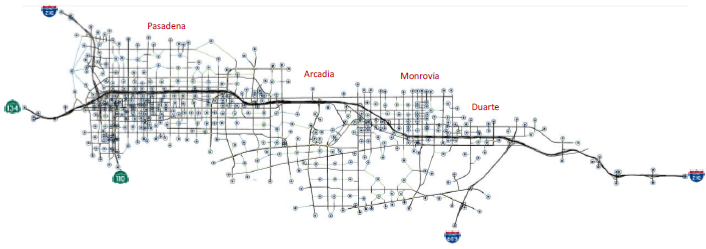
I-210 Corridor Network
A real-world corridor model with 1,000 lane miles, 5,000 traffic detectors, 459 signalized intersections, 45 freeway ramp meters, and Metro Gold Line integration with all bus routes.
Five CV Applications Evaluated
Each application was implemented based on ARC-IT 9.3 physical diagrams and tested across thousands of simulation runs with varying communications, penetration rates, and traffic conditions.
↓ Click any application for the full system design, scenarios, simulation results, and deployment guidance.
Platform Support
Performance Assessment Report
Comprehensive final report detailing system designs, test networks, simulation scenarios, results, and recommendations for all five CV applications.
Aimsun Test Networks
All test networks (ANG files) with embedded DLLs, ready for users to adjust parameters and run additional simulations for their deployment needs.
Future Research Directions
Open Testing Platform for CV Applications
Enabling vendors and OEMs to evaluate their CV solutions before deployment, fostering public-private partnerships for measurable and collaborative deployment.
Adaptive Fixed-Time Signal Control
Feasibility analysis for accelerating CV technology deployment through adaptive timing plans that reduce signal phase uncertainty for connected vehicles.
Training Courses on CV Applications
Comprehensive training for Caltrans engineers on system components, implementation approaches, and deployment best practices for each CV application.